Lucerne - Crop management manual

Barenbrug has developed Yellow Jacket Nitrogenerator®, a seed enhancement which makes it possible to place Rhizobium bacteria directly on the seed. This seed saves labour and increases the certainty of optimal crop establishment. Yellow Jacket Nitrogenerator® embeds bacteria in a polymer matrix around the seed. Extra nutrients and preservatives have been added to this coating to increase shelf life.
Apart from choosing lucerne seed with Yellow Jacket Nitrogenerator®, the right soil type, optimal fertilisation and correct harvesting methods will contribute to high forage yields. This crop management manual provides you with the necessary information to get the most out of your Yellow Jacket Nitrogenerator® lucerne seed.
Establishing a new field
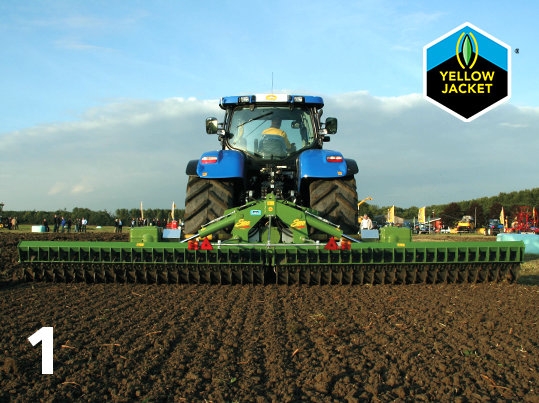
Field requirements
| pH | At least 6. |
| Weed pressure | Select plots with low weed pressure. Grains are ideal preceding crops. Avoid cultivating Lucerne on broken grassland. |
| Drainage level | Well-drained. |
| Soil structure | Remove compacted layers (>45 cm). |
| Pre-crop | No Lucerne should have been grown on the plot for more than 3 years due to auto-toxicity. |
| Soil | Lucerne performs best on loamy sand, loam, and clay soils. |
Read more about field preparation.
Sowing
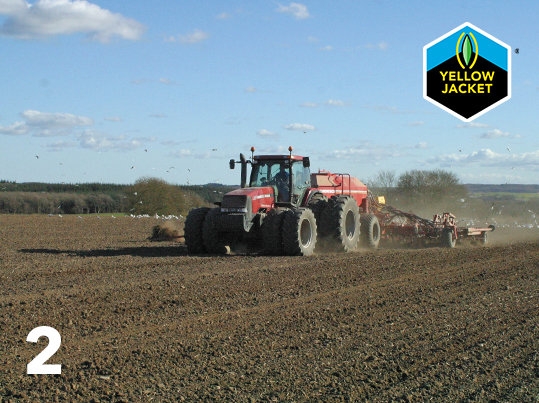
Sowing recommendations
| Sowing period | Mid-March to the first week of September. If there is increased weed pressure, sowing in late summer is best. |
| Seed rate | 25 kg Lucerne per hectare. |
| Cover crop | Lucerne can be combined with 5 kg Duet or 5 kg Protafix. |
| Sowing depth | 1-2 cm. Use a Cambridge roller after sowing. |
| Row distance | 8 - 12.5 cm. Choose a short distance between rows to prevent weeds. |
| Seedbed | Fine top layer but firm seedbed. |
Read more about sowing.
Fertilization
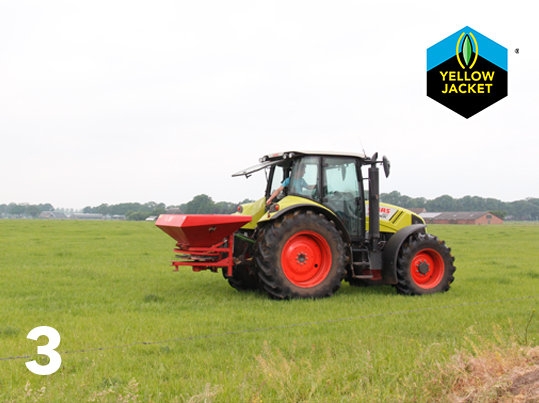
Fertilization recommendations per year per hectare*
| Calcium Carbonate (CaCO3) | Add calcium carbonate to achieve a minimum pH of 6. |
| Nitrogen (N) | In a cold spring, 15-25 kg N as a starter is recommended. |
| Phosphorus (P) | 80 - 110 kg P2O5/ha on sandy and clay soils. |
| Potassium (K) | 260 - 300 kg K/ha on sandy soil. 235 - 270 kg K/ha on clay soil. |
| Magnesium (Mg) | 50 kg MgO/ha on sandy soil only. |
| Sulfur (S) | 20 kg S/ha on sandy and clay soils. |
*Conduct a soil analysis for specific recommendations, including sulfur (S), molybdenum (Mo), and boron (B).
Read more about fertilization.
Weeds and pests control

Weeds and pests control recommendations
| Mechanical control | Mow weeds or remove tops if they grow above the Lucerne. Avoid bare spots: Do not mow Lucerne too short. Prevent tire damage by lowering tire pressure. |
| Chemical control | Contact your local distributor or advisor for information on available products. |
Harvesting
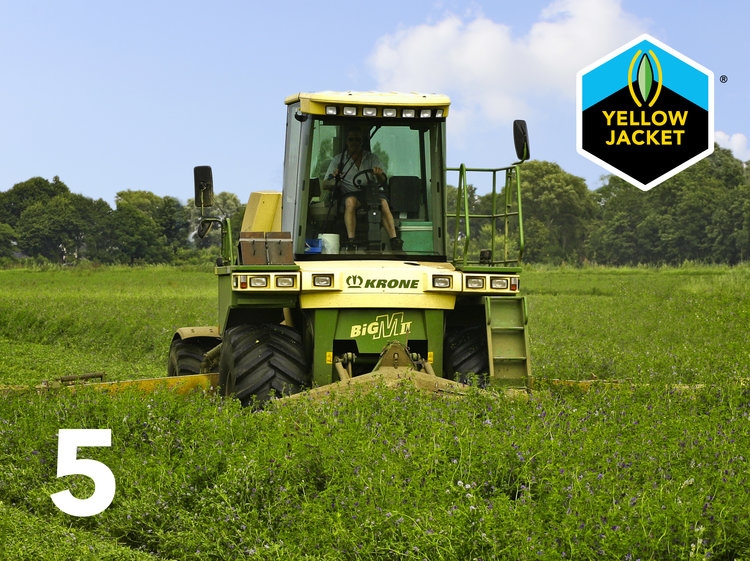
Harvesting recommendations
| Moment of harvest | Cut at 5 - 10 % of flowering plants. |
| Weather conditions | Cut at dry weather conditions only. |
| Stubble length | 7 - 10 cm. Lower cutting heights kills new sprouts. |
| Recovery time | Lucerne needs to re-grow up to 10 – 15 cm before winter strikes. |
| Silage | Reliable silage additives are recommended to reduce silage quality loss. Compress and close silage clamp as fast as possible! |
Read more about harvesting.
Where can you buy lucerne?
Where can you buy lucerne with Yellow Jacket Nitrogenerator®? Click on the button to find one of our distributors. Do you have any questions about lucerne or Yellow Jacket Nitrogenerator? Do not hesitate and send an e-mail to export@barenbrug.nl.